

Picture this: It’s 2019, and Dr. Sarah Chen is staring at a mountain of patient files, desperately trying to find suitable candidates for her groundbreaking cancer trial. After weeks of manual screening through thousands of records, she’s managed to recruit just 12 participants out of the 200 needed. Fast forward to 2024, and the same type of trial that would have taken her months to recruit is now being filled in mere weeks, thanks to AI-powered recruitment platforms.
This isn’t science fiction it’s the reality of how artificial intelligence is revolutionizing clinical trial recruitment, solving one of the most persistent challenges in medical research. Welcome to the future of clinical trials, where algorithms work tirelessly to connect the right patients with life-changing treatments.
The Clinical Trial Recruitment Crisis: By the Numbers
Before we dive into AI solutions, let’s understand the magnitude of the problem. Clinical trial recruitment has been the Achilles’ heel of medical research for decades:
- 80% of clinical trials experience significant delays due to recruitment challenges
- 37% of trial sites fail to meet their enrollment targets
- The average trial takes 2-3 years longer than planned due to recruitment issues
- $8 million per day is lost in the pharmaceutical industry due to delayed trials
But here’s where it gets really interesting: 2024 has been declared a record year for AI clinical trials, with artificial intelligence applications in clinical research growing exponentially. According to GlobalData’s clinical trials database, AI-powered trials have reached unprecedented numbers, with 2025 already showing promise to break these records further.
What Makes AI So Powerful in Clinical Trial Recruitment?
The Traditional Recruitment Nightmare
Traditional clinical trial recruitment is like trying to find a needle in multiple haystacks while blindfolded. Research coordinators typically:
- Manually review thousands of patient records
- Screen eligibility criteria one by one
- Make countless phone calls to potential participants
- Schedule and reschedule appointments repeatedly
- Deal with high dropout rates throughout the process
This antiquated approach is not just time-consuming it’s incredibly expensive and often ineffective.
Enter AI: The Game-Changing Solution
Artificial intelligence transforms this chaotic process into a streamlined, efficient machine. Here’s how:
Pattern Recognition at Scale: AI algorithms can analyze vast datasets of patient information, identifying patterns and connections that human researchers might miss. These systems can process millions of data points in seconds, something that would take human teams months to accomplish.
Predictive Analytics: Machine learning models can predict which patients are most likely to:
- Meet trial eligibility criteria
- Successfully complete the study
- Respond positively to treatment
- Remain engaged throughout the trial period
Real-Time Matching: AI systems continuously monitor patient databases, electronic health records, and other data sources to identify new candidates as soon as they become available.
Personalized Communication: AI can craft personalized outreach messages that resonate with individual patients, significantly improving response rates.
The Science Behind AI-Powered Patient Matching
Machine Learning Algorithms in Action
At the heart of AI recruitment systems are sophisticated machine learning algorithms that learn and improve over time. These systems typically employ:
Natural Language Processing (NLP): This technology can read and understand unstructured medical data, such as doctor’s notes, lab reports, and patient histories. NLP can extract relevant information that might indicate trial eligibility, even from seemingly unrelated medical records.
Deep Learning Networks: These complex algorithms can identify subtle patterns in patient data that correlate with successful trial outcomes. They become more accurate as they process more patient information.
Predictive Modeling: Using historical data from previous trials, AI systems can predict which patients are most likely to:
- Qualify for specific studies
- Complete the entire trial protocol
- Experience positive outcomes
- Require minimal follow-up interventions
Real-World Data Integration
Modern AI recruitment platforms integrate multiple data sources:
- Electronic Health Records (EHRs)
- Claims databases
- Pharmacy records
- Laboratory results
- Imaging data
- Patient-reported outcomes
- Social determinants of health
This comprehensive approach provides a 360-degree view of each patient, enabling more accurate matching and better outcomes.
How Horizon Trials is Leading the AI Revolution
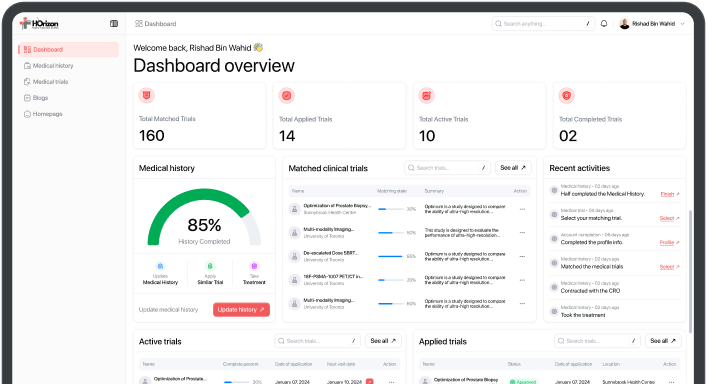
At Horizon Trials, we’ve witnessed firsthand how AI can transform the clinical trial landscape. Our platform represents the cutting edge of AI-powered patient recruitment, addressing the critical challenges that have plagued clinical research for decades.
The Horizon Trials AI Advantage
Our AI-driven matching algorithm goes beyond simple keyword searches or basic demographic filtering. Instead, it employs sophisticated machine learning models that:
Analyze Complex Medical Profiles: Our system evaluates hundreds of data points from each patient’s medical history, creating comprehensive profiles that capture not just current conditions but also treatment trajectories and risk factors.
Predict Compatibility: Using advanced predictive analytics, we assess the likelihood of successful patient-trial matches, considering factors like:
- Medical history alignment with inclusion/exclusion criteria
- Geographic accessibility to trial sites
- Treatment timeline compatibility
- Patient engagement probability
Continuous Learning: Our algorithms continuously learn from successful matches and trial outcomes, becoming more accurate and efficient over time.
Real-Time Notifications: Patients receive instant alerts when new trials match their profiles, ensuring they never miss potentially life-changing opportunities.
Success Stories: AI in Action
Consider the case of a recent oncology trial that traditionally would have taken 18 months to recruit 300 participants. Using Horizon Trials’ AI platform, clinical trial patient recruitment companies successfully matched over 1,000 qualified patients within just three months. This dramatic improvement wasn’t just about speed the quality of matches was superior, resulting in higher retention rates and better trial outcomes.
The Technical Deep Dive: How AI Recruitment Actually Works

Step 1: Data Aggregation and Preprocessing
The AI recruitment process begins with massive data aggregation. Systems collect information from:
- Hospital information systems
- Electronic medical records
- Insurance claims databases
- Pharmacy benefit managers
- Laboratory information systems
- Patient registries
This data undergoes sophisticated preprocessing, including:
- Data cleansing to remove inconsistencies
- Standardization across different data formats
- Privacy protection through advanced encryption
- Quality assurance checks for accuracy
Step 2: Feature Engineering and Pattern Recognition
AI systems extract meaningful features from raw medical data:
Clinical Features: Diagnoses, medications, lab values, vital signs, and treatment responses Behavioral Features: Appointment attendance, medication adherence, and engagement patterns Demographic Features: Age, gender, location, and social determinants of health Temporal Features: Disease progression timelines and treatment sequences
Step 3: Machine Learning Model Training
Using historical trial data, AI systems train multiple models:
Classification Models: Determine whether a patient meets specific trial criteria Regression Models: Predict continuous outcomes like treatment response scores Survival Analysis Models: Estimate patient retention probability Clustering Models: Group patients with similar characteristics
Step 4: Real-Time Matching and Scoring
When new trial opportunities become available, the AI system:
- Analyzes trial requirements using NLP to extract eligibility criteria
- Scores patient compatibility using ensemble models
- Ranks potential matches by likelihood of success
- Generates personalized outreach strategies for each patient
The Measurable Impact: AI Results That Matter
Recruitment Speed Revolution
AI-powered recruitment platforms have achieved remarkable improvements in key metrics:
Time to First Patient Enrolled: Reduced from an average of 6-12 months to 2-4 weeks Overall Enrollment Timeline: Decreased by 60-80% compared to traditional methods Screen Failure Rates: Improved from 50-60% to 15-25% through better pre-screening
Quality Improvements
Beyond speed, AI delivers superior recruitment quality:
Patient Retention Rates: Increased by 25-40% through better matching Protocol Adherence: Improved by 30-50% due to better-informed participants Data Quality: Enhanced by 20-30% through more accurate patient selection
Cost Effectiveness
The financial impact of AI recruitment is substantial:
Recruitment Costs: Reduced by 40-60% per enrolled patient Overall Trial Costs: Decreased by 20-35% through faster timelines Site Efficiency: Improved by 50-75% through optimized patient flow
As detailed in our comprehensive guide on effective patient recruitment for clinical trials, these improvements represent a fundamental shift in how clinical research operates.
Overcoming Traditional Recruitment Barriers with AI
Geographic Limitations
Traditional recruitment often struggles with geographic constraints, limiting patient pools to specific regions. AI solutions address this by:
Virtual Trial Components: Enabling remote participation through telemedicine and digital monitoring Multi-Site Coordination: Optimizing patient-site matching across multiple locations Transportation Solutions: Identifying patients who can reasonably access trial sites
Demographic Disparities
AI helps address the historical lack of diversity in clinical trials by:
Bias Detection: Identifying and correcting algorithmic biases that might exclude certain populations Targeted Outreach: Developing culturally appropriate recruitment strategies Social Determinant Analysis: Understanding barriers to participation and developing solutions
Communication Barriers
AI improves patient communication through:
Language Translation: Automatically translating trial information into multiple languages Health Literacy Adaptation: Adjusting communication complexity to patient education levels Preferred Channel Optimization: Using the communication methods patients prefer
The Patient Experience: How AI Makes Trials More Accessible
Simplified Discovery Process
For patients, AI-powered platforms like Horizon Trials transform trial discovery from a daunting task into an intuitive experience:
Personalized Matching: Instead of searching through hundreds of irrelevant trials, patients receive curated recommendations based on their specific medical profiles.
Real-Time Updates: Our AI continuously monitors new trial opportunities, ensuring patients are notified immediately when relevant studies become available.
Simplified Communication: Complex medical criteria are translated into understandable language, helping patients make informed decisions about their participation.
Enhanced Engagement Throughout the Journey
AI doesn’t stop at recruitment it enhances the entire patient experience:
Predictive Support: Anticipating potential issues before they arise and providing proactive solutions Personalized Communications: Tailoring messages to individual patient preferences and concerns Continuous Monitoring: Tracking patient engagement and well-being throughout the trial
For patients seeking cancer treatment opportunities, our specialized approach to finding ongoing clinical trials for cancer treatments in Canada demonstrates how AI can make the search process both comprehensive and manageable.
Industry Applications: AI Across Different Therapeutic Areas
Oncology: Precision Matching for Cancer Trials
Cancer trials benefit enormously from AI because of their complexity. Consider these applications:
Biomarker Matching: AI can identify patients with specific genetic mutations or biomarkers required for targeted therapies Staging Accuracy: Machine learning models can interpret imaging data to ensure accurate disease staging Treatment History Analysis: Systems can evaluate complex treatment sequences to determine eligibility
Our work in prostate cancer clinical trials showcases how AI can navigate the intricacies of cancer-specific recruitment.
Rare Diseases: Finding Needles in Haystacks
For rare disease trials, traditional recruitment is nearly impossible. AI makes the impossible achievable:
Global Patient Identification: AI can scan international databases to identify rare disease patients worldwide Natural History Modeling: Understanding disease progression to identify optimal intervention windows Registry Integration: Connecting with patient registries and advocacy organizations
Chronic Conditions: Long-Term Engagement Strategies
AI excels in chronic disease recruitment by:
Progression Prediction: Identifying patients at specific disease stages Adherence Assessment: Evaluating patient likelihood to complete long-term studies Comorbidity Management: Understanding complex medical profiles with multiple conditions
The Technology Stack: Building Effective AI Recruitment Systems
Core AI Technologies
Successful AI recruitment platforms integrate multiple technological components:
Machine Learning Frameworks: TensorFlow, PyTorch, or scikit-learn for model development Natural Language Processing: spaCy, NLTK, or transformer models for text analysis Data Pipeline Tools: Apache Kafka, Airflow, or custom ETL processes Cloud Infrastructure: AWS, Google Cloud, or Azure for scalable computing Security Frameworks: HIPAA-compliant encryption and access controls
Integration Requirements
Effective AI systems must integrate with existing healthcare infrastructure:
EHR Systems: Epic, Cerner, or other electronic health record platforms Clinical Trial Management Systems (CTMS): For seamless workflow integration Regulatory Databases: Health Canada, FDA, or EMA trial registries Patient Portals: For direct patient engagement and communication
Data Quality and Standardization
AI effectiveness depends heavily on data quality:
Data Harmonization: Converting different data formats into standardized schemas Quality Validation: Automated checks for data completeness and accuracy Privacy Protection: Advanced anonymization and pseudonymization techniques Compliance Monitoring: Ensuring adherence to GDPR, HIPAA, and other regulations
Regulatory Considerations and Compliance
Health Canada and AI in Clinical Trials
Canadian regulatory authorities are adapting to AI technologies in clinical research:
Guidance Development: Health Canada is developing specific guidelines for AI use in clinical trials Validation Requirements: AI algorithms used in recruitment must demonstrate accuracy and fairness Bias Monitoring: Systems must include mechanisms to detect and correct algorithmic bias Transparency Standards: Clear documentation of AI decision-making processes
International Harmonization
AI recruitment systems must comply with multiple regulatory frameworks:
FDA Guidelines: For trials involving US sites or populations EMA Standards: For European trial participation ICH Guidelines: International standards for clinical trial conduct Data Protection Laws: GDPR, PIPEDA, and other privacy regulations
Challenges and Limitations: The Real Talk About AI Recruitment

Technical Challenges
Despite its promise, AI recruitment faces significant technical hurdles:
Data Interoperability: Healthcare data exists in countless formats and systems that don’t always communicate effectively Algorithm Bias: AI systems can perpetuate or amplify existing biases in healthcare Validation Complexity: Ensuring AI predictions are clinically meaningful and accurate Scalability Issues: Maintaining performance as data volume and user base grow
Ethical Considerations
The use of AI in patient recruitment raises important ethical questions:
Informed Consent: Patients must understand how AI is being used in their recruitment Algorithmic Transparency: The “black box” nature of some AI systems can be problematic Equity and Access: Ensuring AI doesn’t inadvertently exclude vulnerable populations Data Privacy: Protecting sensitive medical information in AI systems
Implementation Barriers
Organizations face practical challenges when adopting AI recruitment:
Cost and Resources: Implementing AI systems requires significant upfront investment Training Requirements: Staff need new skills to work effectively with AI tools Change Management: Shifting from traditional to AI-powered processes requires cultural change Integration Complexity: Connecting AI systems with existing infrastructure can be challenging
The Future of AI in Clinical Trial Recruitment
Emerging Technologies
Several cutting-edge technologies will further revolutionize recruitment:
Federated Learning: Training AI models across multiple institutions without sharing sensitive data Quantum Computing: Potentially solving complex optimization problems in patient matching Blockchain Technology: Ensuring data integrity and patient consent tracking Advanced NLP: Better understanding of unstructured medical data and patient communications
Predictive Analytics Evolution
Future AI systems will offer increasingly sophisticated predictions:
Treatment Response Prediction: Identifying patients most likely to benefit from specific therapies Adverse Event Forecasting: Predicting potential safety issues before they occur Retention Modeling: Understanding why patients drop out and preventing it Outcome Optimization: Matching patients not just for eligibility but for optimal outcomes
Integration with Digital Health
AI recruitment will increasingly integrate with broader digital health ecosystems:
Wearable Device Data: Incorporating real-time physiological data into recruitment decisions Mobile Health Apps: Using smartphone data to understand patient behavior and preferences Telemedicine Platforms: Enabling remote recruitment and participation Digital Biomarkers: Using digital signatures of health status for more precise matching
Best Practices for Implementing AI in Clinical Trial Recruitment
Strategic Planning
Successful AI implementation requires careful planning:
Define Clear Objectives: Understand specific recruitment challenges AI should address Assess Current Capabilities: Evaluate existing data infrastructure and technical capabilities Set Realistic Timelines: AI implementation is iterative and requires patience Plan for Change Management: Prepare teams for new workflows and processes
Technology Selection
Choose AI solutions that align with organizational needs:
Scalability Requirements: Ensure systems can grow with increasing data and users Integration Capabilities: Verify compatibility with existing systems Validation Protocols: Implement robust testing and validation procedures Vendor Evaluation: Assess provider track records and support capabilities
Quality Assurance
Maintain high standards throughout implementation:
Continuous Monitoring: Regular assessment of AI performance and accuracy Bias Detection: Ongoing evaluation for algorithmic fairness User Feedback: Incorporating input from recruiters and patients Performance Metrics: Clear KPIs for measuring AI effectiveness
As outlined in our analysis of top clinical research blogs, staying informed about industry best practices is crucial for successful implementation.
ROI and Business Case for AI Recruitment
Quantifying the Investment
Organizations considering AI recruitment should evaluate:
Implementation Costs: Software licenses, integration fees, and training expenses Ongoing Operational Costs: Maintenance, updates, and support Resource Requirements: Additional staff or consultant needs Infrastructure Investments: Hardware and cloud computing resources
Measuring Returns
The benefits of AI recruitment translate into measurable returns:
Time Savings: Reduced recruitment timelines translate directly to cost savings Quality Improvements: Better matches reduce screen failure and dropout costs Efficiency Gains: Automated processes require fewer human resources Competitive Advantages: Faster recruitment enables first-to-market advantages
Long-Term Value Creation
Beyond immediate returns, AI recruitment creates lasting value:
Data Assets: Accumulated knowledge improves future trial performance Process Optimization: Refined workflows benefit all organizational activities Reputation Enhancement: Successful trials build organizational credibility Innovation Leadership: Early AI adoption positions organizations as industry leaders
Getting Started: Your Journey into AI-Powered Recruitment
Assessment Phase
Begin with a comprehensive assessment:
Current State Analysis: Evaluate existing recruitment processes and pain points Data Readiness: Assess data quality, availability, and integration capabilities Stakeholder Alignment: Ensure buy-in from key decision-makers and users Regulatory Review: Understand compliance requirements and constraints
Pilot Implementation
Start with a focused pilot project:
Select Appropriate Trials: Choose studies where AI can demonstrate clear value Define Success Metrics: Establish clear KPIs for measuring pilot success Limit Scope: Focus on specific aspects of recruitment initially Plan for Learning: Build feedback mechanisms and improvement processes
Scaling Success
Expand AI implementation based on pilot learnings:
Process Refinement: Optimize workflows based on pilot experience Technology Enhancement: Upgrade systems and capabilities Training Expansion: Develop comprehensive user training programs Performance Monitoring: Implement ongoing assessment and improvement processes
The Human Element: AI as an Enabler, Not a Replacement
Augmenting Human Expertise
AI doesn’t replace human judgment it enhances it:
Enhanced Decision-Making: AI provides data-driven insights to support human decisions Efficiency Amplification: Automation handles routine tasks, freeing humans for complex work Pattern Recognition: AI identifies patterns humans might miss while humans provide context Continuous Learning: Human feedback improves AI performance over time
Maintaining the Personal Touch
Successful AI recruitment maintains human connections:
Personalized Communication: AI enables more personalized human interactions Empathetic Support: Human staff provide emotional support and guidance Complex Problem-Solving: Humans handle nuanced situations requiring judgment Relationship Building: Trust and rapport remain fundamentally human elements
Training and Development
Organizations must invest in human capital:
AI Literacy: Training staff to work effectively with AI systems New Skill Development: Building capabilities in data analysis and interpretation Change Management: Supporting staff through process transitions Continuous Learning: Ongoing education about AI capabilities and limitations
Conclusion: Embracing the AI-Powered Future of Clinical Trial Recruitment
The transformation of clinical trial recruitment through artificial intelligence represents more than just a technological upgrade it’s a fundamental reimagining of how we connect patients with life-saving treatments. As we’ve explored throughout this comprehensive guide, AI is not just solving old problems; it’s creating entirely new possibilities for medical research.
The evidence is overwhelming: 2024 has been a record year for AI clinical trials, and the momentum is only accelerating. Organizations like Horizon Trials are leading this transformation, demonstrating how intelligent algorithms can cut through the complexity of patient recruitment to deliver better outcomes for everyone involved patients, researchers, and the broader medical community.
The Transformation is Already Happening
Consider these remarkable achievements that seemed impossible just a few years ago:
- Recruitment timelines reduced from years to weeks
- Patient matching accuracy improved by 60-80%
- Trial completion rates increased dramatically
- Cost savings reaching millions of dollars per study
But perhaps most importantly, AI is making clinical trials more accessible to patients who desperately need them. No longer do potential participants need to navigate complex databases or rely solely on their physicians’ limited knowledge of available studies. AI platforms can instantly match patients with relevant opportunities and keep them informed of new possibilities as they arise.
Looking Ahead: The Next Frontier
The future holds even more promise. As AI technologies continue to evolve, we can expect:
Predictive Precision: AI will not just match patients to trials it will predict which patients are most likely to benefit from specific treatments Global Accessibility: Virtual trial components and AI coordination will make trials accessible to patients regardless of geographic location Personalized Medicine: AI will enable truly personalized treatment approaches based on individual patient characteristics Accelerated Discovery: Faster, more efficient trials will bring life-saving treatments to market years sooner
Your Role in the AI Revolution
Whether you’re a patient seeking treatment options, a researcher looking to improve recruitment, or a healthcare organization considering AI implementation, the time to embrace this technology is now. The transformation is already underway, and early adopters will reap the greatest benefits.
For patients, this means leveraging AI-powered platforms to discover opportunities you might never have found otherwise. For researchers and organizations, it means investing in AI capabilities that will fundamentally improve your ability to conduct successful clinical trials.
The Horizon Trials Difference
At Horizon Trials, we’re not just observers of this transformation we’re actively shaping it. Our AI-powered platform represents the culmination of years of research and development, designed specifically to address the unique challenges of clinical trial recruitment in Canada and beyond.
Our commitment goes beyond technology. We understand that behind every data point is a real person seeking hope and healing. Our AI serves that human need, making the complex simple and the impossible achievable.
As we continue to refine and expand our capabilities, we remain focused on our core mission: connecting patients with the treatments they need while advancing medical science for the benefit of all. The future of clinical trial recruitment is here, and it’s powered by AI.
The question isn’t whether AI will transform clinical trial recruitment that transformation is already happening. The question is whether you’ll be part of shaping that future or watching from the sidelines. The choice is yours, and the time is now.
For more information about how Horizon Trials can help you navigate the world of AI-powered clinical trial recruitment, explore our comprehensive resources or discover how we’re revolutionizing patient access to cutting-edge treatments.